Chessboard Pdf Open Cv Face Detection
What are the internal workings of the OpenCV function findChessboardCorners? How does OpenCV find chessboard corners? Circle detection opencv. The projected chessboard pattern are measured with the help of calibrated camera and the image points are directly acquired. OpenCV start detecting the corners from that corner. And its application to face recognition systems”.
Well, OpenCv comes with its function findCheckerboardCorners() in C++ which goes like
After using this function for a while, one thing that i understood was that the pattern size must comply with the image to a very good extent, else the algorithm refuses to detect any Chessboard altogether. I was wondering if there were any random image of a chessboard, this function would fail as it is impractical to enter the precise values of the patternSize. Is there a way, the patternSize for this function could be obtained from the image provided. Any help would be appreciated. Thanks.
Opencv C++ Face Detection

2 Answers
Short answer: you cannot.
Opencv Chessboard Image
The OpenCV checkerboard detection code assumes that the pattern is uniform (all squares have the same size) and therefore, in order to uniquely locate its position in the image, two conditions must attain:
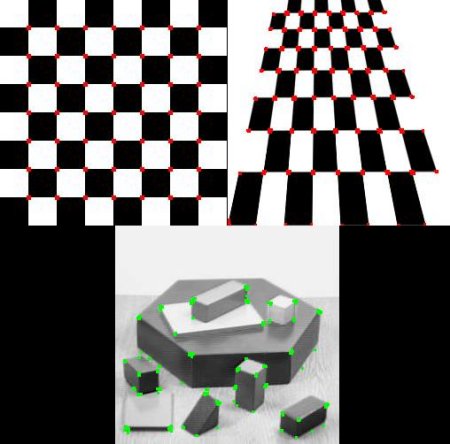
- The pattern must be entirely visible.
- The pattern must have known numbers of rows and columns.
If either 1 or 2 is violated there is no way to know which corner is, say, the 'top left' one.
For a more general case, and in particular if you anticipate that the pattern may be partially occluded, you must use a different algorithm and a non-uniform pattern, upon which corners can be uniquely identified.
There are various way to do that. My favorite pattern is Matsunaga and Kanatani's '2D barcode' one, which uses sequences of square lengths with unique crossratios. See the paper here. In order to match it, once you have sorted the corners into a grid, you can use a simple majority voting algorithm:
- Precompute the crossratios of all the pattern's consecutive 4-tuples of corners, in both the horizontal and vertical directions.
- Do the above for the detected corners in the grid.
- For every possible horizontal shift
- Over every row
- Accumulate the number of crossratios that agree within a threshold
- Over every row
- Select the horizontal shift with the highest number of agreements.
- Repeat the above for every possible vertical shift, counting crossratios along the columns.
Placing the detected corners in a grid can be achieved in various ways. There is an often-rediscovered algorithm that uses topological proximity. The idea is to first associate each corner to all the squares within a small window of it, thus building a corner->squares table, and then traverse it as a graph to build a global table of the offsets of each corner from one another.
The doc for findChessboardCorners says that
patternSize – Number of inner corners per a chessboard row and column
So patternSize is not the size of the chessboard inside the image but the number of inner corners. The number of inner corners does not depend from the size of the chessboard inside the image.
For example for the following image https://github.com/Itseez/opencv/blob/3.1.0/samples/data/chessboard.pngpatternSize should be cv::Size(7,7).